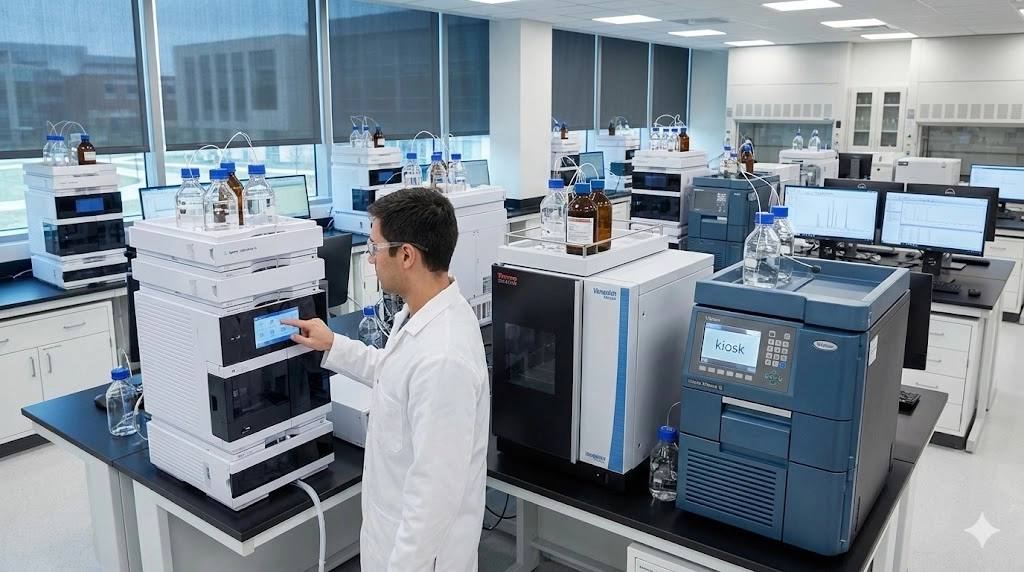
Nanoparticles are no longer limited to advanced laboratories; they are widely used in everyday products like medicines, cosmetics, food, and water treatment systems. To ensure safety, quality, and performance, accurate measurement is essential. Instruments such as the Nanoparticle Size Analyzer, Zeta Potential Analyzer, and Dynamic Light Scattering Analyzer play a key role in understanding particle behavior and stability.
These tools are now essential across multiple industries. With growing demand in Saudi Arabia under Vision 2030, reliable Material Characterization Equipment is becoming increasingly important for industries and research centers. In this blog, we will explore their applications and importance.

What is Zeta Potential Analysis?
Zeta potential is the electrical charge present on the surface of particles suspended in a liquid. It shows how particles behave in a solution, whether they stay stable and separate or start sticking together.
A higher positive or negative value (usually above ±30 mV) means better stability, while lower values indicate a higher chance of particle aggregation. This measurement is performed using a Zeta Potential Analyzer, which helps researchers and industries ensure product stability and quality.
In many applications, zeta potential analysis is combined with particle size measurement using a Dynamic Light Scattering Analyzer. This makes DLS-based systems an important part of modern Material Characterization Equipment. This provides a complete understanding of dispersion behavior and formulation performance.

How Nanoparticle Analysis Is Used in Pharmaceuticals, Food, Cosmetics, and the Environment
1. The Role of Precision in Pharmaceutical Drug Development
In the pharmaceutical sector, accuracy in particle measurement is essential for safe and effective medicines. The importance of particle size analysis in pharmaceuticals lies in how it directly affects drug absorption, dissolution rate, and overall bioavailability. Smaller particles often improve drug performance, especially for poorly soluble medicines.
Particle size also plays a critical role in inhalation drugs, injectable formulations, and tablet uniformity. Inhalers require specific particle ranges to reach the lungs properly, while injectables must meet strict safety limits to avoid blockages. Consistent particle size ensures uniform dosing in tablets and capsules.
The role of particle size analyzers in drug delivery systems is vital in modern nanomedicine, including liposomes and nanoemulsions, where size and stability decide how drugs travel in the body. A DLS analyzer supplier in Saudi Arabia provides advanced systems that help researchers measure these properties accurately.
For laboratories, choosing a reliable particle size analyzer supplier in Saudi Arabia is essential for high-quality pharmaceutical research and production support.
2. The Role of Quality, Stability, and Safety in the Food Industry
In food science, particle size analysis in the food industry is essential for controlling texture, taste, and product stability. Products like juices, sauces, milk, and dressings depend on uniform particle distribution to remain stable and appealing over time. Poor particle control can lead to separation and reduced shelf life.
A zeta potential analyzer supplier in the KSA plays an important role here, as zeta potential helps determine whether food emulsions will stay stable or break down. Stable zeta values ensure better product consistency and safety.
Food processing also depends on particle control during milling and grinding of ingredients like sugar, spices, and cocoa. This directly impacts texture, solubility, and flavor release.
As the food sector evolves, Environmental nanoparticle testing instruments and advanced analyzers are also being used for safety monitoring and quality control in modern food labs.
3. The Role of Formulation Science in Cosmetic Industry Performance
The cosmetics industry relies heavily on particle science for product quality and performance. Nanoparticle characterization in skincare products is now a standard part of cosmetic product development, ensuring that creams, serums, sunscreens, and foundations deliver the desired results.
Particle size affects how products feel on the skin, how they spread, and how active ingredients penetrate. For example, sunscreen effectiveness depends on correctly sized nanoparticles like titanium dioxide and zinc oxide, which also reduce visible residue.
Modern brands use cosmetic formulation analysis equipment to ensure stability, safety, and consistency across batches. A DLS analyzer supplier in Saudi Arabia provides tools that help maintain product quality through precise particle size and stability testing.
4. The Role of Environmental Science in Pollution and Water Monitoring
Environmental research is rapidly growing, especially in areas like water and soil safety. Environmental nanoparticle testing instruments are used to study how nanoparticles behave in natural systems, including rivers, lakes, and groundwater.
These tools help researchers understand particle stability, movement, and potential environmental impact.
In wastewater treatment research, particle and zeta potential measurements are essential for improving coagulation and flocculation processes. By adjusting particle charge, treatment plants can remove contaminants more efficiently and reduce operational costs.
A trusted Zeta potential analyzer supplier in the KSA supports environmental labs and research centers with accurate instruments needed for water quality testing and pollution monitoring.
Choosing the right particle size analyzer supplier in Saudi Arabia and advanced laboratory solutions helps research and industrial labs achieve consistent, high-quality results across all applications.
Why Material Characterization Is Essential Across Multiple Industries
Across industries like pharmaceuticals, food, cosmetics, and environmental science, particle behavior at the nano and micro-level plays a major role in product performance and safety. Even though these particles are invisible to the eye, they directly impact drug effectiveness, food quality, skincare results, and water safety. Material characterization equipment helps convert hidden particle behavior into clear, measurable data for better decision-making.
Tools like particle size and zeta potential analyzers support the Role of particle size analyzers in drug delivery systems within pharmaceutical nanotechnology, ensuring medicines work safely and effectively.
In beauty and personal care, Nanoparticle characterization in skincare products, Cosmetic Formulation Analysis, and Cosmetic product development rely on accurate measurements to maintain stability and performance. Wastewater treatment research uses these instruments to monitor and improve water quality, making lab results more reliable and consistent across applications.
Conclusion
Particle size and zeta potential are key measurements used to check product quality, safety, and performance in industries like pharmaceutical nanotechnology, cosmetic product development, food processing, and wastewater treatment research. They help ensure stability and reliable results in real applications. If you are in KSA and looking for a nanoparticle-size analyzer, zeta potential analyzer, or dynamic light scattering analyzer, Apex Instrument provides complete support from selection to installation and calibration.
FAQs
1. What is a nanoparticle size analyzer?
A nanoparticle size analyzer is an instrument that measures the size distribution of particles at the nano- or micro-scale.
2. What is zeta potential analysis?
It is the measurement of the surface charge on a particle in suspension, which tells you how stable a dispersion will be.
3. What is a dynamic light scattering analyzer used for?
A dynamic light scattering analyzer measures how light scatters off moving particles to calculate their size. It is used for measuring nanoparticle size in pharmaceutical, cosmetic, and food labs.
4. How does particle size affect pharmaceuticals?
The importance of particle size analysis in pharmaceuticals comes down to drug absorption, dissolution rate, and dosing accuracy. Smaller particles dissolve faster and are absorbed more efficiently by the body.
5. What is the role of particle size analyzers in drug delivery systems?
The role of particle size analyzers in drug delivery systems is to ensure that drug-carrying nanoparticles are the right size and stability to reach their target site in the body effectively.
6. Why is zeta potential important in cosmetics?
Zeta potential analysis helps cosmetic formulators understand whether a cream, serum, or lotion will stay stable over its shelf life. Low zeta potential means the product is likely to separate or degrade.
7. What is nanoparticle characterization in skincare products?
Nanoparticle characterization in skincare products means checking the size, surface charge, and stability of tiny ingredients such as UV filters and active carriers to ensure they are safe, stable, and effective in use.
8. How is particle size analysis used in the food industry?
Particle size analysis in the food industry is used to assess emulsion stability, control milling processes, and ensure consistent texture and shelf life of products like dressings, juices, and dairy items.
9. What is cosmetic formulation analysis?
Cosmetic formulation analysis is the process of checking a cosmetic product’s physical and chemical properties, such as particle size and zeta potential, to make sure it is stable, effective, and safe for skin use.
10. What are environmental nanoparticle testing instruments used for?
Environmental nanoparticle testing instruments are used to detect, measure, and characterize nanoparticles in water, soil, and air samples, helping researchers assess environmental risks and design better treatment solutions.
11. What is the connection between zeta potential and wastewater treatment?
In wastewater treatment research, zeta potential measurement helps engineers understand how particles behave in water and how much coagulant is needed to remove them, directly impacting treatment efficiency and cost.
12. Where can I find a particle size analyzer supplier in Saudi Arabia?
Apex Instrument is a reliable particle size analyzer supplier in Saudi Arabia, offering a range of DLS and particle size instruments from internationally recognized brands with regional support.
13. Who is a trusted zeta potential analyzer supplier in the KSA?
Apex Instrument is a trusted zeta potential analyzer supplier in the KSA, supplying quality instruments for pharmaceutical, cosmetic, food, and environmental labs across the Kingdom.
14. Is Apex Instrument a DLS analyzer supplier in Saudi Arabia?
Yes, Apex Instrument is a well-established DLS analyzer supplier in Saudi Arabia, with experience supporting pharmaceutical, cosmetic, food, and environmental labs with the right material characterization equipment.
15. What is cosmetic product development, and how does particle size factor in?
Cosmetic product development is the process of creating and testing new beauty and skincare products. Particle size directly affects how active ingredients penetrate the skin and how stable the product remains.
16. What is material characterization equipment?
Material characterization equipment includes instruments like nanoparticle size analyzers, zeta potential analyzers, SEM, and surface area analyzers that are used to measure and understand the properties of materials.
17. What is pharmaceutical nanotechnology?
Pharmaceutical nanotechnology involves the use of nanoparticles to improve drug delivery, bioavailability, and targeting. It relies heavily on particle size and zeta potential analysis to develop and quality-control formulations.
18. Can DLS measure zeta potential too?
Many modern dynamic light scattering analyzers include zeta potential measurement capability in the same instrument, making them very efficient for labs that need both measurements regularly.
19. What particle size range can a nanoparticle size analyzer measure?
Most DLS-based nanoparticle size analyzers can measure particles from about 1 nm up to several micrometers, covering the full nanoparticle range used across pharmaceuticals, food, and cosmetic applications.
20.How does zeta potential affect food emulsions?
A high zeta potential in a food emulsion means the droplets repel each other and stay evenly distributed. When zeta potential drops, droplets merge and the product separates, which is both a quality and a shelf-life problem.
21.Why is particle size important in sunscreen formulations?
In sunscreen, particle size controls both UV protection efficiency and the white cast left on skin. A nanoparticle size analyzer is used during cosmetic product development to optimize the formulation.
22.What industries use zeta potential analyzers most?
A zeta potential analyzer is widely used in pharmaceutical nanotechnology, cosmetic formulation analysis, particle size analysis in the food industry, and wastewater treatment research.
23.How often should a particle size analyzer be calibrated?
Calibration frequency depends on how often the instrument is used and the regulatory requirements of your industry.
24.What is a polydispersity index (PDI) in particle size analysis?
PDI tells you how uniform the particle size distribution is in your sample. A low PDI means most particles are similar in size, which is usually ideal in pharmaceutical nanotechnology and cosmetic formulation analysis.
25.Can environmental nanoparticle testing instruments handle complex water samples?
Yes, modern zeta potential analyzers and dynamic light scattering analyzers can handle real-world environmental samples.
26.How does particle size relate to drug bioavailability?
Smaller drug particles have more surface area, which helps them dissolve faster and get absorbed better in the body, making particle size analysis very important in pharmaceuticals.
27.What should I look for when buying a zeta potential analyzer?
Look for measurement range, ease of use, software capability, and after-sales support from your zeta potential analyzer supplier in the KSA.
28.Is cosmetic formulation analysis equipment expensive?
The cost varies depending on the features and brand. A combined nanoparticle size analyzer and zeta potential analyzer is a worthwhile investment for any serious cosmetic product development lab, with options available at different price points.
29.How does Apex Instrument support labs in KSA?
As a leading particle size analyzer supplier Saudi Arabia, Apex Instrument provides instrument supply, installation, calibration, training, and ongoing technical support to labs across the Kingdom, including pharmaceutical, food, and cosmetics sectors.
30.How do I contact Apex Instrument for analytical instruments in KSA?
You can visit us and speak with the team about nanoparticle size analyzers, zeta potential analyzers, DLS analyzers, and other material characterization equipment.
Contact:
Upgrade research with advanced particle size and zeta potential analyzers and contact us for complete instruments and lab solutions today.
Mobile/WhatsApp: +971526191767
Email: sales@apex-instrument.com